
Draft
Strategy Brief v2.0 · 22 open questions · 6 blocking · Platform readiness added as Section 07 · Prepared for review
Business Strategy Brief · Version 2.0
Local merchants have a distribution problem, not a software problem.
Your Hometown.
Your Neighbours.
Your Community.
Your Customers.
Discovery is the wedge. Software and payments are the monetization. Everything in this document follows from that one bet — and HomeTown.Social is the only part of the ecosystem that cannot be bought off a shelf.
4
Entities
11
Sections
22
Open
6
Blocking
1
Live market
How to read this document
This rewrites Version 1.0 with the argument restructured and the gaps made visible rather than papered over. Where information was missing, you will find an open marker instead of an invented number.
This version has been revised against the live HomeTown.Social platform, which answered several questions the first draft had to leave blank — and surfaced one new risk serious enough to warrant its own section.
📋
Executive Summary
01Website builders, CRMs, booking tools, and payment processors are commodity goods in 2026 — cheap, abundant, largely undifferentiated. What a local business cannot buy off the shelf is a reliable stream of nearby customers who already trust them. They rent that stream from Google, Meta, and the marketplaces, at rising cost, and it stops the moment they stop paying.
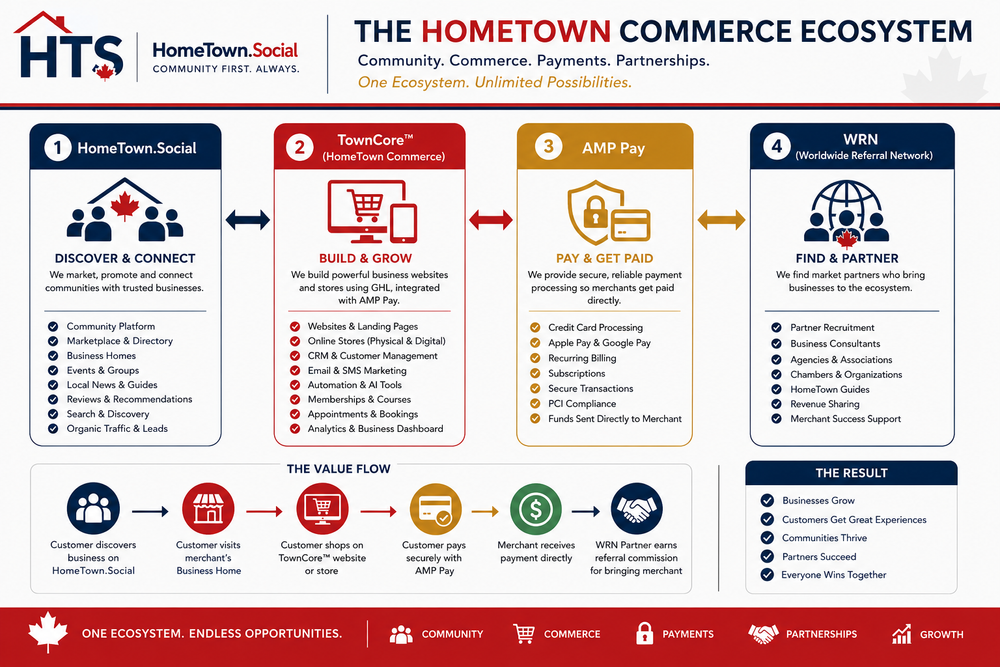
The HomeTown Commerce Ecosystem rests on a single bet: if you own community-level discovery, you can attach the commerce stack to it at low acquisition cost and high retention.
Demand
HomeTown.Social
Community discovery platform. Monetizes attention and placement.
Operations
TownCore™
Business operating system. Monetizes recurring subscriptions.
Transactions
AMP Pay
Payment processing. Monetizes transaction volume.
Distribution
WRN
Partner network. Absorbs merchant acquisition cost.
Merchants retain ownership of their customers, site, data, and payment relationship. That is a deliberate constraint, not a marketing line — Section 05 explains why it is also a defensible commercial position rather than a concession.
Confirmed from the live platform
HomeTown.Social is live and shipping, at v1.59.1, on Ghost with a members layer, a daily news edition, community feeds, events, business listings, a badge and referral system, and role structures that already include Referral Consultant, Community Leader, Chapter Leader, HomeTown Guide, and three tiers of WRN membership.
Delta is market one — North Delta, Ladner, Tsawwassen, Sunbury — with Vancouver, Surrey, Langley, and Chilliwack named as the expansion set, each running its own deployment.
🎯
The Problem We Are Solving
02For the merchant
- Acquisition cost has risen faster than local margins, and paid channels reset to zero the day the budget stops.
- The average local business runs four to seven disconnected tools that do not share data, so nothing compounds.
- Marketplaces that do deliver demand take ownership of the customer relationship, leaving merchants renting access to their own buyers.
For the community
- Local discovery has fragmented across platforms optimized for national advertisers rather than for a specific neighbourhood.
- Consumers say they want to buy local, then default to whatever ranks first. Intent exists; the surface to act on it does not.
For our partners
- Consultants, agencies, and chambers already hold the trust relationship with local merchants. They lack a product that captures recurring value rather than one-time project fees.
Open · Question 12
Do we have primary research, merchant interviews, or Delta pilot data behind these claims? The editorial argument is well made on HomeTown.Social already; the strategy document needs evidence, not just position.
🏛
The Four Entities
033.1 HomeTown.Social — Demand
Role: generate qualified local demand and route it to merchants, through the community feed, daily news edition, events, marketplace, business directory, groups, neighbourhood feeds, and member profiles.
Not in scope: payment processing, storefront hosting, order management. HTS hands off; it does not transact.
Success is measured by qualified referrals delivered per merchant per month. Not members, not posts, not listings — referrals. Every other number on the platform is a leading indicator of that one.
Resolved — this was the biggest gap in v1.0
The first draft asked what gives a resident a reason to open HomeTown.Social twice in a week. The live platform has answered it: a dated daily news edition, published under the HomeTown Social and HomeTown Journal mastheads. That is a genuine habit driver, and it is the correct one — directory browsing never becomes a habit, local news does.
The strategic implication is that editorial is not marketing overhead. It is the demand engine, and it should be staffed and budgeted as core infrastructure.
3.2 TownCore™ — Operations
Role: the system a merchant runs their business on once demand arrives. White-labeled GoHighLevel, integrated with AMP Pay, presented entirely as HomeTown. The merchant never interacts with the underlying platform.
Capabilities: sites and landing pages, online stores, appointment booking, CRM, email and SMS, automation, AI content, funnels, forms, reputation management, subscriptions, analytics, dashboards.
Stated plainly: building on GoHighLevel is right for speed and capital efficiency, and it creates real dependency. Margin, roadmap, and continuity sit partly with a third party. That is a managed risk, not an absent one, and it should be disclosed to investors rather than discovered by them.
3.3 AMP Pay — Transactions
Role: process payments and monetize the volume the ecosystem creates. Funds move from customer to merchant; neither HTS nor TownCore takes possession of merchant funds.
Open · Question 1 · Blocking
Is AMP Pay a registered ISO, a payfac, a referral partner to a processor, or a wholly owned entity? This determines the take rate, the regulatory obligations, the capital requirements, and whether the payments revenue line is real. It is the single most load-bearing unknown in this document.
3.4 WRN — Distribution
Role: acquire merchants through trusted intermediaries rather than direct sales headcount.
Why this matters more than it appears: WRN is not a channel program bolted on the side. It is what makes the unit economics work. Direct sales to local merchants at SMB price points does not pay for itself; a $150-per-month subscription cannot carry a $1,200 fully loaded acquisition cost on a 24-month payback. Partner-led acquisition converts a fixed sales cost into a variable revenue share — the difference between a model that scales and one that does not.
Already built
The referral infrastructure exists and is more developed than v1.0 suggested: an append-only referral audit trail, manual credit correction, network visibility controls, and a tiered badge ladder running from first referral through Connector, Neighbour, Ambassador, Champion, and Legend. WRN Member, WRN Premium, and WRN Market Partners are live roles.
What is missing is not the tracking. It is the money.
Open · Question 4 · Blocking
What does a WRN partner earn? Upfront bounty, residual percentage, residual duration, clawback terms, and whether payments revenue is shared. Badges motivate community members; they do not motivate a chamber of commerce or a marketing agency to stake a client relationship.
🔄
How the Ecosystem Compounds
04- Resident opens the daily edition on HomeTown.Social
- Discovers a business through the feed, directory, or an event
- Visits that merchant's Business Home
- Converts on the merchant's TownCore site or store
- Pays through AMP Pay
- Merchant receives funds; transaction data enriches the CRM
- Better data improves targeting, ranking, and repeat purchase
- Merchant success becomes proof for the WRN partner
- Partner introduces more merchants; local supply deepens
- More reason for residents to return — and the loop tightens
Each pass should lower blended acquisition cost and raise retention. If it does not, the ecosystem thesis is wrong and this is four mediocre point solutions in a trench coat. That is the falsifiable claim at the centre of the business, and Delta is where it gets tested.
🧭
Positioning
05What we are not
We are not building a better Shopify. Storefront software is not scarce.
What we are
The commerce operating system for a place. Every merchant gets a way to be found, to tell their story, to sell, to communicate, and to grow — connected, in one system. Open · Q13
The merchant-ownership position
Merchants own their customers, site, data, and payment relationship. Competing marketplaces do the opposite, and merchants have learned what that costs.
This is not charity and should not be pitched as such. It is a commercial trade: we give up the ability to disintermediate our merchants, and in exchange we get a lower-friction sale, better retention, and a credible reason for chambers and economic development organizations to endorse us — a channel closed to marketplace-model competitors by construction. Ownership is our moat with the channel, not a favour to the merchant.
The integration argument, made properly
Version 1.0 conceded that no single component is revolutionary. True, and conceded too quickly. The defensible form: a merchant running five vendors has five bills, five logins, five support paths, and zero data flowing between them. Their marketing does not know what their POS knows. Consolidation is worth real money, and every additional surface they run on us raises switching cost and improves the data that makes the next surface work better. The integration is the product. The components are inputs.
Actual competitive set
Version 1.0 benchmarked against Shopify, Meta, and Google. Those are not who we lose Delta merchants to.
| Competitor | Where they beat us | Where we beat them |
|---|---|---|
| Square / Toast / Clover | Installed base, hardware, trust | No community demand layer |
| Yelp / Nextdoor | Consumer traffic already exists | No commerce or CRM stack |
| Wix / Squarespace / GoDaddy | Brand recognition, price | No demand generation |
| GoHighLevel agencies | Same tools, existing relationships | Community layer, editorial, payments |
| Local marketing agencies | Deep local trust | Cannot deliver recurring software economics |
| Local papers & community Facebook groups | Free, entrenched, already habitual | No commerce path, no merchant tooling |
Note rows four and six. Any GoHighLevel agency can replicate the TownCore stack in a weekend, and any community Facebook group already owns the attention we are competing for. HomeTown.Social and WRN are the defensible assets; TownCore and AMP Pay are the monetization. Resource accordingly.
🚀
Go-to-Market: Solving the Cold Start
06The ecosystem is coherent at steady state and inert at zero. HTS delivers no referrals without merchants and residents; TownCore is a commodity CRM without HTS referrals; WRN partners will not stake client relationships on an unproven product.
Delta is already the answer to "which town first." The remaining question is what has to be true there before a second market opens.
Phase 1 · Delta
Prove one community
Keep publishing the daily edition — it is the habit driver and the reason anyone returns. Seed the supply side: populate business listings across North Delta, Ladner, Tsawwassen, and Sunbury whether or not those merchants have paid, so arriving residents find a populated platform. Convert a first cohort to paid TownCore.
Exit criteria: a defined number of qualified referrals per paying merchant per month, and monthly logo churn under a defined ceiling. If these are not met, fix the model before opening market two.
Phase 2 · Adjacent
Prove it repeats
Vancouver, Surrey, Langley, Chilliwack. The goal is a documented, transferable playbook and the first WRN partners running it without direct involvement. Success is whether a partner-led launch performs within a defined margin of a founder-led one.
Phase 3 · Scale
Partner-led growth
WRN becomes the primary growth engine. The central team shifts from launching markets to enabling partners.
Two structural questions
- Is the unit of expansion the community or the partner? Geography-first builds density and network effects but scales slowly. Partner-first scales quickly and risks thin coverage everywhere and defensibility nowhere. These need different products, comp plans, and capital. The plan currently implies both. Open · Q5
- What is the minimum merchant and member density at which HTS becomes useful? Below that threshold, referral volume is not low — it is zero, and every paying merchant churns. Estimate it before launch, not after. Open · Q16
⚙️
Platform Readiness
07This section is new, and it exists because reviewing the live platform changed my assessment of what the binding constraint actually is. It is not strategy. It is infrastructure.
HomeTown.Social currently runs on a combination of Ghost, JSONBin, browser localStorage, and a partial Supabase migration. That stack is a reasonable way to get a community platform in front of real residents quickly, and it has clearly worked — the product is live, feature-rich, and further along than most pre-seed platforms. The concern is not what it took to get here. It is what it cannot carry next.
Three constraints that block the commerce layer
- Data durability. A system where records can exist only in one browser's cache, where saves can fail silently when storage fills, and where recovery requires a person to open the right device and push data up, is not a system merchants can run a business on. The moment a merchant's customer list lives there, an ordinary browser cache clear becomes a business-ending event for them and a liability for us.
- Authentication. Four-digit PINs held client-side are appropriate for a neighbourhood feed. They are not appropriate for an account that will hold customer records, and they are nowhere near what a payment integration will require. This has to change before AMP Pay touches anything, and changing it later means migrating every member account that exists by then.
- Shared-tier storage limits. Payload ceilings that require periodic image cleanup are workable for a single community. They do not survive five communities, and they will not survive merchant media.
What this means strategically
The commerce ecosystem described in this document cannot be layered onto the current data foundation. The migration to a durable backend is not a technical chore to schedule alongside growth — it is a precondition for the revenue model, and it is the most urgent item on the roadmap. The Cloudflare direction already named in the platform roadmap is a sound destination; what matters is sequencing it before merchant and payment data arrives rather than after.
There is a real opportunity cost argument for moving now: every member, listing, and referral record created before the migration is a record that has to be moved, reconciled, and verified later.
Open · Questions 6, 17, 18 · Blocking
What is the migration plan and timeline, who owns it, and what is the hard rule about which features may launch before it completes? Specifically: does merchant onboarding wait for the durable backend, or does it proceed in parallel?
Smaller items worth a pass
- Public social links in the site footer still point to the Ghost theme's own accounts rather than HomeTown.Social's.
- The default Ghost publication cover is serving as the Open Graph image, so shared links do not carry the brand.
- Public member, post, and business counters currently display zero to signed-out visitors. On a community platform, visible emptiness is a conversion problem — consider showing them only past a threshold.
💰
Business Model and Unit Economics
08Open · Questions 2, 3, 9–11 · Blocking
This section is a template showing what must be filled, not a proposal. No figure below has been supplied.
Revenue by entity
HomeTown.Social — sponsorship of the daily edition, featured listings, sponsored content, premium placement, community sponsorships, membership upgrades. The sponsorship inventory is already built into the product. Realistically modest early: this platform's job is to lower TownCore's acquisition cost, and it should be resourced as demand generation rather than held to a near-term revenue target.
TownCore — recurring subscription across Starter, Growth, Professional, Enterprise, plus setup, store build, AI services, marketing packages, implementation, training, support. Four tiers are named with no prices, which is the first thing any reader looks for. Open · Q2
AMP Pay — processing spread, transaction revenue, subscription billing. Take rate depends entirely on the structure question in 3.3.
WRN — a cost line before a revenue line. Commissions and residuals reduce contribution margin; enterprise partnerships may offset. Model it as acquisition cost.
What must be established
| Metric | Status |
|---|---|
| Blended merchant CAC — partner-led | Open · Q11 |
| Blended merchant CAC — direct | Open · Q11 |
| Average revenue per merchant / month | Open · Q2 |
| Gross margin after GHL + processing | Open · Q3 |
| Monthly logo churn | Open · Q11 |
| Payback period | Open · Q10 |
| LTV : CAC | Open · Q10 |
| Cost to launch one community | Open · Q11 |
| Cost to publish a daily edition per market | Open · Q14 |
Two of these govern everything else: gross margin after platform costs and payback period. If GoHighLevel wholesale plus support plus partner commission consumes most of the subscription price, the software line is an acquisition vehicle for payments rather than a business — and the plan should be rebuilt around payments economics deliberately rather than by accident.
The last row is new, and it is not a small one. Daily local editorial is the demand engine, which makes it a recurring per-market cost that must appear in the launch model for every community, not just Delta.
⚠️
Risks
09| Risk | Assessment | Mitigation |
|---|---|---|
| Data durability | Now the top risk. Current storage cannot carry merchant or payment data. | Complete the durable-backend migration before merchant onboarding |
| Authentication model | Client-side 4-digit PINs are incompatible with a payments product | Replace before AMP Pay integration; migrate existing accounts once |
| Cold start | Referral volume must materialize or paying merchants churn | Phase 1 exit criteria; do not open market two on hope |
| Editorial dependency | The daily edition drives the habit; it is also a fixed recurring cost per market | Model it per market; test partial automation before scaling |
| GoHighLevel dependency | Margin, roadmap, continuity partly outside our control | Term and price floors; own the data layer; bound migration cost |
| AMP Pay structure undefined | Determines whether payments revenue is real | Resolve before fundraising |
| Channel conflict | GHL agencies sell the same stack to the same merchants | Compete on demand generation, not software |
| Partner quality | WRN partners represent the brand with limited direct control | Certification, performance floors, right to remove |
| Key-person concentration | Editorial, platform, and strategy appear to run through very few people | Document the playbook; hire against the narrowest dependency first |
| Incumbent response | Square or Yelp adding the adjacent layer | Community relationships are slow to replicate; speed to density matters |
✅
What Version 1.0 Got Right
10- The four-entity separation is clean and the boundaries are correctly drawn.
- Merchant ownership of customers, data, site, and gateway is a real differentiator with a real channel benefit.
- Partner-led acquisition is the correct structural answer to SMB acquisition cost — and the referral infrastructure to support it is already built.
- The flywheel logic is sound, and the daily edition solves the habit problem that usually kills local platforms.
- Separating communities (places) from groups (interests) is a genuinely good product decision and a real differentiator against Facebook.
- "Operating system for community-powered commerce" is a position no incumbent occupies end to end.
❓
What I Need to Finish This
11Down from 30 in the first draft — the live platform answered eight of them. The first six change the shape of the document; the rest fill it in.
Blocking 6
- What is AMP Pay, legally and commercially? ISO, payfac, referral partner, or owned entity? Who underwrites? What is the effective take rate net of interchange and processor cost?
- What are the four TownCore prices, and what distinguishes each tier?
- What does GoHighLevel cost us per merchant, at what volume tiers, and on what contract terms — length, price protection, termination, white-label rights?
- What does a WRN partner earn? Bounty, residual percentage, residual duration, clawback, and whether payments revenue is shared.
- Is the unit of expansion the community or the partner?
- What is the backend migration timeline, and does merchant onboarding wait for it? This is the question that determines whether the commerce layer is a next-quarter or next-year conversation.
Current state 3
- How many real members, businesses, and posts exist in Delta today, behind the sign-in wall?
- Are there paying merchants yet, and any revenue from any line?
- Who is on the team, and which of the four entities has a named owner?
Financial 3
- What capital has been raised or committed, what is runway, and are we raising against a milestone?
- Does a financial model exist that this document should align to?
- Any real CAC, churn, or ARPU data — even a handful of merchants beats an assumption.
Market and product 5
- Do we have Delta merchant interviews or pilot data to support the problem statement?
- What is the target merchant profile — revenue band, size, categories — and which categories are we deliberately not pursuing first?
- What does it cost to produce the daily edition per market, and can any of it be templated or partly automated without losing the local voice that makes it work?
- Do Business Homes and My Homes™ connect to TownCore sites, or are they separate surfaces a merchant has to maintain twice?
- What is the minimum merchant and member density for HTS to deliver referrals?
Operational and legal 5
- Who owns the backend migration, and what is the sequence?
- What is the authentication replacement plan, and when do existing accounts migrate?
- Who onboards and supports a merchant, who pays for it, and what is the target time from signature to live storefront?
- What happens when a merchant churns — do they keep the site, export the data, retain the payment relationship? The ownership promise needs an operational answer.
- Are HTS, TownCore, AMP Pay, and WRN separate legal entities or divisions of WBN News Corp, and what is the mark status on each? Does the GoHighLevel agreement permit the full white-label presentation described in 3.2?
Brand 1
- Exact brand tokens. This document is matched to HomeTown.Social by structure and idiom — ticker, counters, emoji tabs, card feed, badge language — but the palette and typefaces are inferred, not lifted. Send the hex values and font names and it becomes an exact match in one pass.
Answer the six blocking questions and this becomes a complete document. Answer the first eleven and it survives diligence.
Every open marker is a decision not yet made, not a gap in the writing. The one that gates the rest is question six: until the data layer can carry a merchant's business, the commerce ecosystem is a plan rather than a product.
HomeTown Commerce Ecosystem · Strategy Brief v2.0 · Draft · 22 open questions
Reviewed against HomeTown Social™ · WBN News Corp™ · Every Community Has A Home.
Reviewed against HomeTown Social™ · WBN News Corp™ · Every Community Has A Home.